Verónica Costa Neves, a researcher at the Institute of Marine Sciences – OKEANOS of the University of the Azores, is co-author of two recently published scientific articles that contribute to our understanding of seabird distribution across the Atlantic and the importance of specific ocean habitats for their foraging and conservation.
The two studies address different research scales, from seabird movements across the Atlantic Ocean to the influence of specific features of the seafloor, such as seamounts, on the distribution of marine megafauna.
Seabirds reveal priority areas for conservation across the AtlanticPublished in Conservation Letters, the article “
Highly Mobile Seabirds Reveal Areas of Conservation Importance Across the Atlantic Ocean” analyses the movements of different seabird species and identifies regions of the Atlantic that are particularly important for their conservation.
Travelling thousands of kilometres throughout the year, these species use foraging areas that frequently extend beyond national borders and into international waters. The results highlight the importance of the high seas, showing that some of the regions used by seabirds have ecological value comparable to that of waters under national jurisdiction, despite benefiting from significantly lower levels of protection.
The study reinforces the need for an Atlantic-wide conservation approach that considers species movements, connections between different habitats and international cooperation.
Seamounts: true oases in the oceanThe second article, published in Oceanography, is entitled “
Establishing the Attractiveness of Seamounts to Marine Megafauna as a Useful Marine Conservation Tool” and explores the potential of seamounts as areas of particular ecological importance for marine megafauna.
Although hidden beneath the ocean's surface, these underwater mountains can influence ocean currents, promote water mixing and favour the concentration of organisms that provide food for top predators, including seabirds.
In the Azores, research into the relationship between seamounts and seabird foraging areas has revealed particularly interesting findings. In the case of
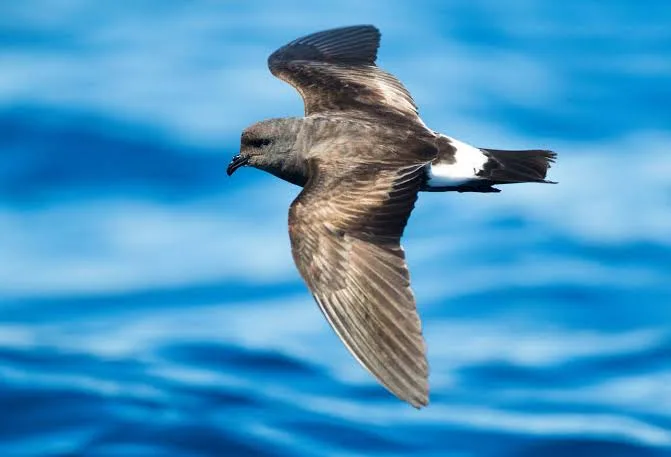
Monteiro's storm petrel, an endemic species of the Azores, seafloor depth and proximity to seamounts were the strongest predictors of its foraging locations. These patterns remained consistent across four consecutive breeding seasons.
Cory's shearwaters from Corvo Island also travel to regions of the Mid-Atlantic Ridge characterised by numerous seamounts. In these areas, depth gradients and productivity fronts influence the amount of time birds spend at their foraging grounds.
These findings demonstrate that the underwater landscape, although invisible from the surface, can play a key role in food availability and seabird distribution.
From scientific knowledge to conservationTogether, the two studies highlight the importance of integrating different research scales to identify priority areas for marine conservation. While the Atlantic-wide study helps identify large regions used by seabirds throughout the year, research on seamounts helps explain the oceanographic and ecological processes that make certain locations particularly important.
This knowledge can contribute to assessing and improving marine protected area networks, taking into account not only breeding colonies on land but also the foraging habitats and migratory routes used by seabirds across the ocean.
Looking ahead, it will be essential to strengthen the monitoring of seabird movements, improve our understanding of prey distribution and assess the effectiveness of existing conservation measures. As highly mobile species that depend on dynamic environments, seabirds require marine protected area networks capable of adapting to ocean changes and promoting cooperation between countries and regions.
As Verónica Costa Neves highlights, “colonies, foraging grounds and migratory routes are all part of the same life. Protecting them therefore requires an integrated vision of the Atlantic and the ecological connections that cross it.”
Scientific publications- Rouyer, M.-M., A. S. L. Rodrigues, T. E. Davies, et al. (2026). Highly Mobile Seabirds Reveal Areas of Conservation Importance Across the Atlantic Ocean. Conservation Letters, 19(5), e70075. [https://doi.org/10.1111/con4.70075]-Broadus, L. J., G. Carroll, J. González-Solís, L.-A. Henry, A. B. Leitner, S. U. Stæhr, C. Göke, A. M. Holbach, V. C. Neves, V. H. Paiva, P. Quillfeldt, F. Ventura, M. Frederiksen, and C. Mohn (2026). Establishing the Attractiveness of Seamounts to Marine Megafauna as a Useful Marine Conservation Tool. Oceanography, 39(1), 34–43. [https://doi.org/10.5670/oceanog.2026.e108]








 LUÍS VALENTIM
 VALTER MEDEIROS