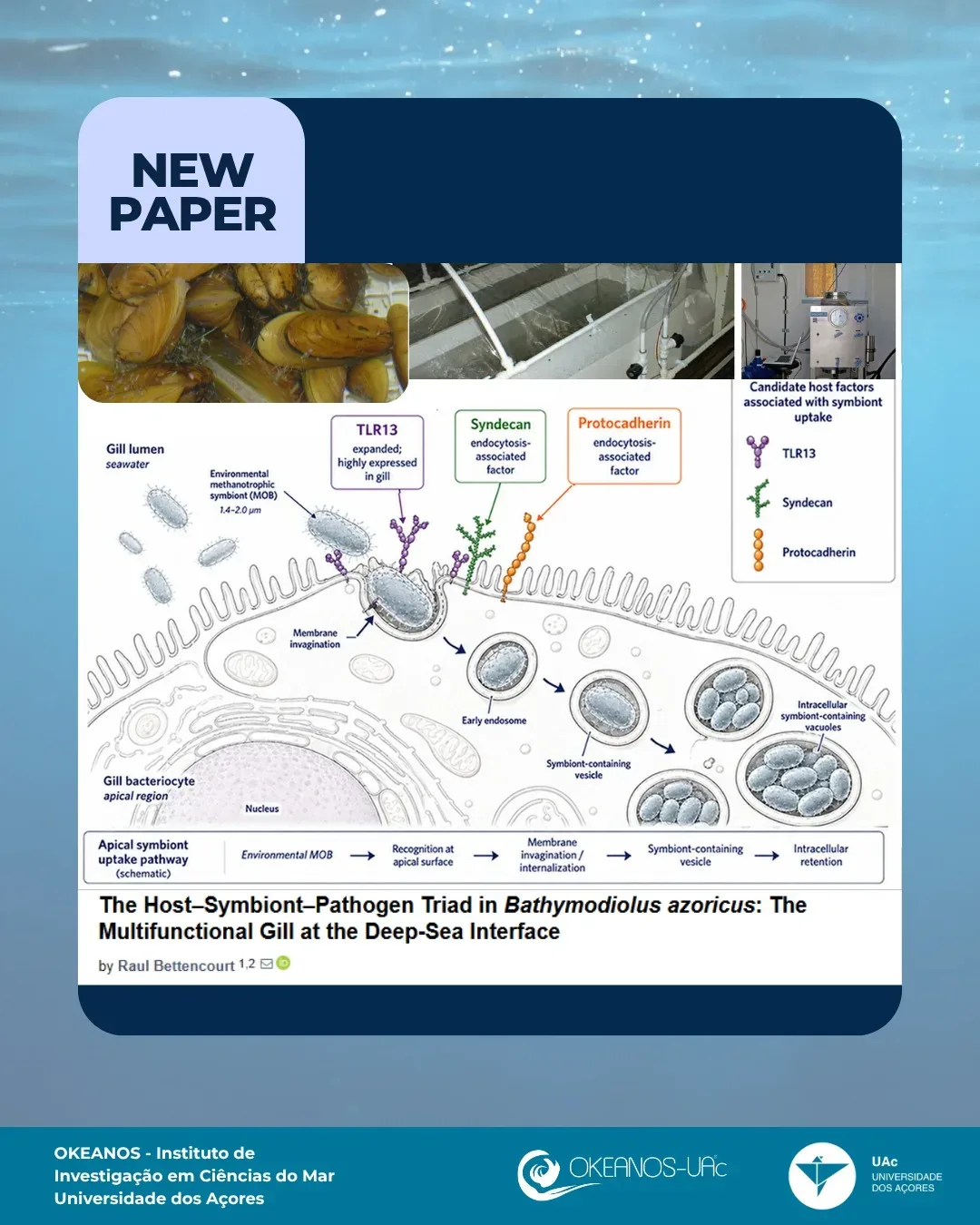
Published in Marine Drugs, the review article “The Host–Symbiont–Pathogen Triad in Bathymodiolus azoricus: The Multifunctional Gill at the Deep-Sea Interface” explores a fundamental biological question: how can a deep-sea animal maintain an effective immune system while simultaneously harboring the beneficial bacteria on which much of its nutrition depends?
Focusing on the hydrothermal vent mussel Bathymodiolus azoricus, an emblematic species of deep-sea chemosynthetic ecosystems of the Mid-Atlantic Ridge, the review brings together two decades of research on its cellular immunity, gill transcriptome, responses to microbial challenge and symbiotic biology, integrating these findings with recent mechanistic studies from other bathymodioline mussels.
The gill emerges as a central organ in this relationship. It houses intracellular sulfur- and methane-oxidizing symbiotic bacteria that provide nutrition to the mussel, while at the same time remaining continuously exposed to microorganisms from the surrounding seawater. Evidence from B. azoricus shows that the gill can mount local immune responses to bacterial challenge, that components of the hemolymph can differentially modulate immune-gene expression in response to symbiotic and non-symbiotic bacteria, and that immune activity varies along different regions of the developing gill.
Based on these observations, the review proposes a host–symbiont–pathogen triad as an integrative framework for understanding how B. azoricus may reconcile microbial symbiosis with immune defence. Rather than relying on generalized immune suppression, the available evidence points towards a more spatially and developmentally organized system in which immune competence changes as gill tissue develops and matures.
The review highlights several important directions for future research, including:
- Determining how immune competence changes at the level of individual gill cell types and across different regions of the gill;
- Clarifying the mechanisms involved in symbiont recognition, uptake, intracellular maintenance and digestion;
- Characterizing still poorly understood components of B. azoricus immunity, including antimicrobial peptides and the prophenoloxidase system;
- Investigating how cellular immune checkpoints interact with gill development and symbiont colonization;
- Exploring the broader biotechnological relevance of biological mechanisms that allow persistent microbial symbiosis to coexist with effective immune surveillance.
By placing the gill at the center of a spatially structured immune system, this work reinforces B. azoricus as an important model for understanding how animals living in extreme deep-sea environments balance cooperation with beneficial microorganisms and defense against potentially harmful ones.
The article is available in open access: Bettencourt, R. (2026). The Host–Symbiont–Pathogen Triad in Bathymodiolus azoricus: The Multifunctional Gill at the Deep-Sea Interface. Marine Drugs, 24(9), 312.https://doi.org/10.3390/md24090312PT Publicado na revista Marine Drugs, o artigo de revisão “The Host–Symbiont–Pathogen Triad in Bathymodiolus azoricus: The Multifunctional Gill at the Deep-Sea Interface” aborda uma questão biológica fundamental: como pode um animal de mar profundo manter um sistema imunitário eficaz e, simultaneamente, albergar as bactérias benéficas das quais depende grande parte da sua nutrição?
Centrando-se no mexilhão de fontes hidrotermais Bathymodiolus azoricus, uma espécie emblemática dos ecossistemas quimiossintéticos de mar profundo da Dorsal Mesoatlântica, esta revisão reúne duas décadas de investigação sobre a sua imunidade celular, transcriptoma branquial, respostas a desafios microbianos e biologia da simbiose, integrando estes conhecimentos com estudos mecanísticos recentes realizados noutras espécies de mexilhões batimodiolíneos.
A brânquia assume um papel central nesta relação. É neste órgão que se encontram bactérias simbiontes intracelulares oxidantes de enxofre e metano, que contribuem para a nutrição do hospedeiro, ao mesmo tempo que a superfície branquial permanece continuamente exposta aos microrganismos presentes na água do mar. Estudos realizados em B. azoricus mostram que a brânquia é capaz de desencadear respostas imunitárias locais perante desafios bacterianos, que componentes da hemolinfa podem modular diferencialmente a expressão de genes relacionados com a imunidade em resposta a bactérias simbiontes e não simbiontes e que a atividade imunitária varia entre diferentes regiões da brânquia em desenvolvimento.
Com base nestas observações, a revisão propõe uma tríade hospedeiro–simbionte–patógeno como modelo integrador para compreender de que forma B. azoricus poderá conciliar a simbiose microbiana com a defesa imunitária. Em vez de uma supressão generalizada do sistema imunitário, as evidências disponíveis apontam para uma organização mais complexa, espacial e dependente do desenvolvimento, na qual a competência imunitária se modifica à medida que o tecido branquial se forma e amadurece.
A revisão identifica várias linhas prioritárias para investigação futura, incluindo:
- Determinar como a competência imunitária varia ao nível dos diferentes tipos celulares e regiões da brânquia;
- Esclarecer os mecanismos envolvidos no reconhecimento, aquisição, manutenção intracelular e digestão dos simbiontes;
- Caracterizar componentes ainda pouco conhecidos da imunidade de B. azoricus, incluindo os péptidos antimicrobianos e o sistema da profenoloxidase;
- Investigar a relação entre os mecanismos celulares de controlo dos simbiontes, o desenvolvimento da brânquia e a sua colonização;
- Explorar a relevância biotecnológica mais ampla de mecanismos biológicos que permitem a manutenção de simbioses microbianas persistentes sem perda da vigilância imunitária.
Ao colocar a brânquia no centro de um sistema imunitário espacialmente organizado, este trabalho reforça B. azoricus como um importante modelo para compreender de que forma os animais que vivem em ambientes extremos do mar profundo conseguem equilibrar a cooperação com microrganismos benéficos e a defesa contra microrganismos potencialmente prejudiciais.
O artigo encontra-se disponível em acesso aberto: Bettencourt, R. (2026). The Host–Symbiont–Pathogen Triad in Bathymodiolus azoricus: The Multifunctional Gill at the Deep-Sea Interface. Marine Drugs, 24(9), 312. https://doi.org/10.3390/md24090312










 LUÍS VALENTIM
 VALTER MEDEIROS